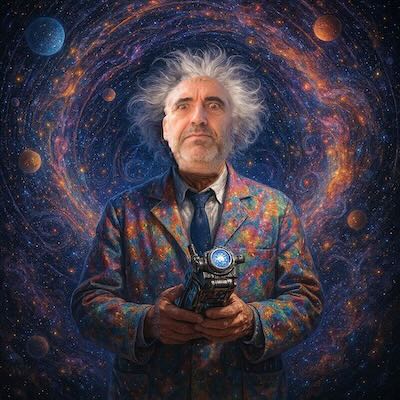
The idea for this article came to me through contact with another exuberant theorist, An M. Rodriguez, passionate about fundamental physics and great unsolved scientific enigmas in general. He sought my opinion on his self-published works, The Emergence of Self (how causal loops, imprinting, and internal piloting give rise to self-awareness) and The Physics of Energy Flow (deriving all known physics from electromagnetic energy). Enormous ambitions for small, concise books (less than 100 pages) supported by simplified mathematics.
Browsing through them and examining the author’s profile, I have a bit of a sense of seeing myself in a mirror, although An is much younger. The same complete lack of modesty, claiming to easily solve the mysteries that baffle even the greatest scientists. The same enthusiasm for his solution. The same limited academic background on the subjects addressed, which are extremely difficult. An holds a bachelor of science degree (four or five years of university-level scientific training) and presents himself as an “independent researcher in fundamental physics.” I myself hold a medical degree specializing in rheumatology (thirteen years of university study) but remain self-taught in most of the disciplines I’ve explored: physics, neuroscience, and sociology. This doesn’t prevent me from claiming the only relevant Theory of Everything today. Nothing less!
The reader may legitimately question the relevance of our speculations. Are we eccentric showmen, amusing because we’re convinced of the authenticity of our magic tricks? Are we going about things backward, unaware that strokes of genius come from true scientists and not from self-proclaimed magicians? This requires some clarification, which begins with a question: Is the best specialist in each discipline best placed to judge the state of their field within the broader context of other knowledge?
A perverse question, isn’t it? We could declare that the best physicist is the most competent to comment on their discipline. The same goes for other fields, including the humanities. But who is qualified to speak for the entire collection? There are contenders. Arrogance isn’t unique to eccentrics like us; it extends to two fields: physics and philosophy. Physics attempts to drag the other sciences down from below, through reductionism. Philosophy seizes them from above, by deifying the mind, irrefutably superior to matter. Caught between these two princesses, the other sciences, poor plebeians, are content to mind their own business. They get along rather well among themselves, while physics and philosophy squabble over insoluble disputes.
It is precisely this antagonism that led me to Surimposium, my general theory. The conflict stems from a dualism, with materialists at the bottom asserting that everything originates from physical processes, and philosophers at the top asserting that the mind cannot be reduced to them. Why do I say “at the bottom” and “at the top”? You can guess: I am referring to the complex dimension, from simple mechanisms at its base producing extraordinarily complicated things at its summit.
Our two princesses are positioned at opposite ends of the spectrum. Physics resembles the god Hephaestus, bent over his subterranean forge assembling materials, while philosophy is personified as Apollo, perched on the belvedere of the arts and reason. But then, doesn’t true monism in this world arise from what both separates and unites them? From this very complex dimension?
There are many other prolific theorists besides An Rodriguez and myself, brimming with enthusiastic ideas about the world. We all, in fact, have an Inventor in our brains, busy reweaving concepts and subjecting them to reality, or keeping them to ourselves. Our dreams, for example, are the product of this Inventor, and we don’t declare them real. But the boundary is blurred. Our mental landscape is a representation that strives to adhere to reality, without ever being quite the world itself.
This is the heart of the paradox of the complex dimension. The processes that rise from its base always express themselves in the same way, through repetitive behavior that science strives to codify. The consciousnesses that descend from the summit listen in ever-changing ways, to a multitude that philosophy seeks to encompass. How can we bring together the one and the many, physical singularity and spiritual diversity? This paradox guided the writing of Surimposium.
Many are the passionate amateur theorists, and their approaches vary. An Rodriguez courageously tackled the foundations of physics by challenging physicists on their own turf: the realm of equations. Unable to assess its relevance, I just get the impression that he’s attacking iron swords with a wooden weapon. One positive point: he uses an upward perspective, meaning he starts with the postulates of physics and tries to unify them. Before forces, fields, and particles, let’s focus on energy! That’s the right method. Others have tried with information. Less seriously, some adventurers have proclaimed the existence of a universal field of consciousness. My own founding principle is less substantial: it’s the conflict between individuation and belonging.
But again, this conceit: how can I claim that a method is good or bad? To be honest, I’ve never dared to confront specialists on their own turf, except when it comes to my own field. Trying to outdo the most specialized reveals one’s own limitations. My approach is more detached. I don’t evaluate knowledge itself, but rather the framework within which it is situated. Everyone does the same, of course, but we have general frameworks that are more or less efficient. In most sciences, the framework is the system. The model adjusts to the system through experimentation. Within these limits, everything works well. And some frameworks are so incredibly vast that we don’t even think of looking for a larger one. Einsteinian spacetime isn’t a handkerchief! Nevertheless, the spectacular size of dimensions shouldn’t obscure the fact that they remain tied to a specific framework. And if this framework can’t explain everything observable, then it must itself be part of a more encompassing dimension.
This is how the complex dimension, in Surimposium, serves as a library for other disciplines without impacting their core business. All their successes are accepted and placed on their shelves. None are definitive. Many books end up gathering dust. Why? Because they haven’t managed to extend their model beyond a system of thought that’s too narrow. So, which essays are the most promising? Those that break free from their system, their author, overflow the shelves, and demonstrate a transdisciplinary approach.
Surprisingly, these successes are few and far between. Yet, there is no shortage of thinkers on complexity, but their names will mean little to most of you: Spencer, von Bertalanffy, Wiener, Prigogine, Koestler, Simondon, Kaufmann, Maturana and Valera, and of course, Edgar Morin. Why hasn’t their reputation extended beyond a small circle of initiates? The reasons are manifold. Complexity belongs to all disciplines and yet is not one of them. There is no entry point for it into a research lab or a university. Nor is there a specific career path. You understand the whole picture better through the lens of complexity, but practical applications come from targeted research. All you need to do is identify where to act, and reality, naturally complex, will take care of drawing all its levels of existence into the desired transformation. There’s no need to know how it does it. The research funder is primarily interested in the result.
Ultimately, there’s little audience for amateur theorists. Either because they’re trying to compete with professionals on their own turf, like An Rodriguez; but the field is crowded with highly regarded players. Or because they’re seeking a transdisciplinary framework, like me; but then the field is deserted, apart from a few unknowns wandering around, and without an audience to take an interest.
One last explanation for the absence of fans wearing t-shirts bearing our image in the streets: Stigler’s Law of Eponymy. It states that “a scientific discovery is never named after its author.” Is it systematically stolen? No. Two factors contribute to this harsh “law.” On the one hand, a discovery doesn’t spring from nothing, and it’s often the complementer, rather than the initiator, who reaps the glory. On the other hand, the inventor is often too obsessed with their invention to market it effectively. They’ve never had the time to develop a realistic view of the world, or even simply to experience it. They’re crazy and eccentric. Others are more pragmatic and better salespeople. It’s their names that endure. The facilitator overshadows the inventor.
Sorry, my dear An, energy flow and surimposition will have other names than ours and will leave us penniless. But I propose we found the eponymous association that will unite them: the Circle of the Inverted Cascade, where together we will witness the magnificent spectacle of this energy flow gushing towards the heights of complexity. Champagne!!
*