
The Problem
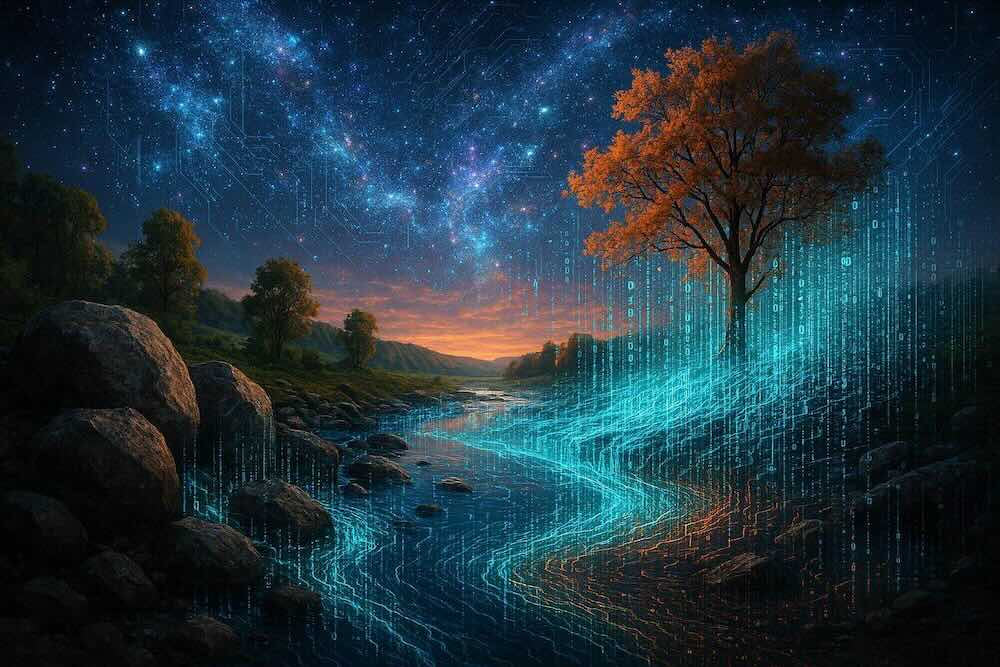
Physics has rendered matter transparent, to the point of becoming spectral. Atoms have become particles, themselves mere excitations of fields, and fields are nothing but information. The current trend in physics is to define reality in terms of pure information, as you can read on Vlatko Vedral’s very interesting blog. This trend was initiated by John Wheeler (it from bit) and Carl von Weizsäcker (who replaced the classical bit with a quantum bit, a superposition of all its possible states). We should also mention Max Tegmark (Mathematical Universe Hypothesis), who considers the physical world a pure expression of mathematical language.
What becomes of the substance of things in all this? It no longer exists! Reduced to the state of an illusion for the relational systems that are our neural networks. What appears materially consistent to us is merely the transformation of sensory information into categories of things by our brain, whose role is to discriminate the environment. Information is sorted by other information. It is tempting, then, to see all of reality as made up of information, as these physicists do.
Who are the rebels against this idea? Spiritualists come to mind first. A reality of intertwined numbers doesn’t seem very compatible with souls and deities. Yet many mystics are seduced by it. Doesn’t the disappearance of all substance reveal this Great Whole common to spiritual traditions, whether it is called God in the West, Allah in the Middle East, or the Akasha in India? Especially since quantum theory asserts that no information is ever lost. Here we are, preserved in our singularity within the fundamental layer of the world. There is no longer any inconsistency today in being a computer scientist and a follower of these traditions.
The true rebels are the skeptical philosophers, incensed by this science that abolishes phenomena. An illusion of substance, but an illusion for whom, for what exactly? We are incapable of defining the phenomenon of consciousness in terms of information. Have physicists excluded themselves from reality, considering themselves merely sites of an illusion and not subjects of consciousness?
The Solution
Since information is by definition relational, it says nothing about what is related. If there were no things in relation, then the concept of relation itself loses its meaning. We must grasp the enormity of this obstacle before speaking of a reality made of information. This is definitively only the best way to grasp reality, nothing more. For it is impossible to extract ourselves from this reality to see its origin. Whatever our efforts, we will always be within it, studying its nature with concepts that are also inherent in its nature.
There is, however, a way to connect information and substance (of which things in relation are made) without leaving reality. This is the theory I presented in ‘Surimposium’. A substance is the global level of a system of related elements. The system is indeterminate, but its global level is determinate. How do we move from one to the other? The global level is the determined configuration of all the system’s probabilities. This configuration changes, of course, but not at the same time rate as the system’s interactions. This lag, which can be dramatic, defines what we call substance. Stability upon instability. Each layer of complexity can add greater stability. We thus arrive at the substantial fixity of the macroscopic over the myriad probabilities of its quantum constitution.
This theory requires no assumptions about the origin of reality. It simply follows its guiding thread through complexity, which turns out to be the true fundamental dimension of reality.
Reality is not made of information but of organization. It is organic. That’s more alive, isn’t it?
*