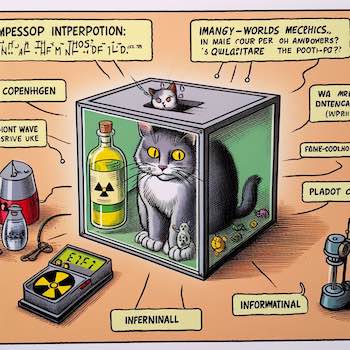
The principle of relative independence illustrated by the Tetralogue

The principle of relative independence is at the heart of Surimposium, a complete theory of reality. I illustrate this with an excerpt from Timothy Williamson’s Tetralogue, before showing an outlet for the political relationship between rulers and governed. The principle of relative independence How does an individuation declare its independence? You have to look for … Read more

On the pluralism of methods

Attacking causal cognition Lara Kirfel and Tobias Gerstenberg support the pluralism of methods for studying causal cognition. They quote Feyerabend: « If we want to understand nature, if we want to master our physical surroundings, then we must use all ideas, all methods, and not just a small selection of them. » Paul Feyerabend, Against Method / … Read more

How does the brain represent the world?

A brain that gets brushed! A baby looks at a brush. The object has no meaning for her. She sketches one when her mother grabs it to straighten her hair. Years later, the brush is part of a rich mental universe of utensils with well-defined functions. It proposes itself to the consciousness of the baby … Read more

Transactional Analysis and Psociety

Proven usefulness in psychotherapy Eric Berne is a pioneer in the description of psychic persona , that is to say recognizable states that can take the ego of a person. He sees 3 fundamentals, Parent Child and Adult. The Parent is protector and director, the imaginative Child plaintive and playful, the Adult objective and independent. … Read more

Taking action

Switch Charles Pépin makes a brilliant essay on How to Take Action. His advice can be summed up as follows: “Prepare to never be ready.” Certainties hinder action, disorient us if the course is not compliant. To decide is “to go there to see […] go there because we don’t know enough […] otherwise, we … Read more

Two speeds for thought?

Pretentious turtle and dumb rabbit In psychology, theories with double thought processes generally oppose unconscious automatic mode and conscious controlled mode. They were popularized in particular by Daniel Kahneman in ‘System 1 / System 2, The Two Speeds of Thought‘ (2012). If the book has been so successful, it is because it is easy to … Read more

Me, researcher, dishonest?

Morals Test Bench Philomag’s newsletter is back in force after the summer break with a study of 1098 students in 10 countries comparing utilitarian and deontological morals. By testing students’ behavior through games of dice and sums to be won, researchers come across a counterintuitive result: those who proclaim their attachment to an intangible moral … Read more

Can we be lucid and happy?

The nature of mental objects Before answering this question, let us judge its relevance. Are lucidity and happiness comparable, opposable, associable? Certainly lucidity seems a brake on happiness, pointing to all the reasons to lack it. But are these concepts of the same nature? What is a mental “nature”? We admit that an emotion and … Read more

Brush clearing ontological classifications

Warning The very idea of “ontological” classification is suspect. What is the being of a thing by reference to the thing alone? By definition it is the only one to experience it. A hook for knowledge: being results from a constitution. But if we think we know the constitution per se —the being of the … Read more